
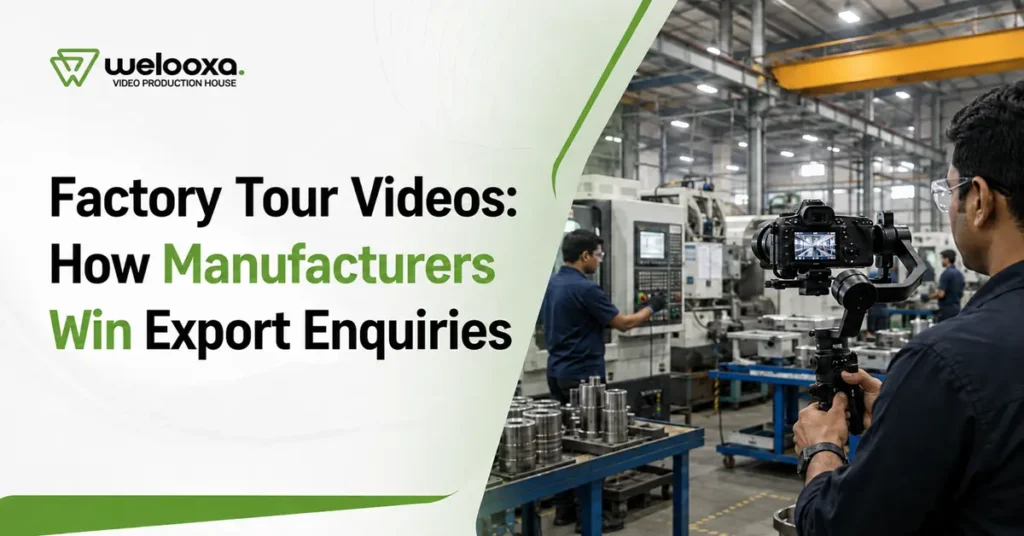
A factory tour video wins export enquiries by proving your plant is real before the buyer asks. Overseas buyers cannot visit your unit, so they shortlist suppliers using whatever evidence exists online. A four-minute walkthrough showing machines, operators, QC stations and dispatch answers their verification questions in one click.
Most manufacturers already own a factory video. The problem is what’s in it: a drone shot of the shed, background music, the MD talking in a boardroom, and not one frame that answers what the buyer is actually thinking. Which is never “are you impressive?” It is “if I place a ₹1.5 crore order, will it ship on time, to spec, from a plant that exists?”
This guide covers what buyers look for, the exact shot list, where to publish each cut, and what it costs in India.
What Is a Factory Tour Video?
A factory tour video is a filmed walkthrough of a manufacturing facility that shows production capability in sequence: raw material intake, machining or assembly, in-process quality checks, final inspection, packing and dispatch. It usually runs between 90 seconds and six minutes and is used in export marketing, RFQ replies and supplier verification.
It is not a corporate film. A corporate film sells the brand. A factory tour video proves the plant. The two need different footage, which is why so many manufacturing videos look expensive and convert nothing.
Three versions are worth separating, because buyers treat them differently:
- Edited factory tour video – a produced, narrated walkthrough. Your marketing asset. Lives on your site and marketplace profiles.
- Virtual factory tour – a 360° version the buyer navigates area by area.
- Live remote factory audit – a scheduled video call where the buyer’s auditor directs your camera in real time.
The first two you control. The third you don’t, and that is exactly why buyers trust it most.
Why Buyers Ask for Factory Video
An export enquiry rarely dies because your price was high. It dies because the buyer could not get comfortable enough to continue the conversation.
Sourcing Is a Risk Decision
The importer carries the cost of a wrong choice: a delayed container, a rejected consignment, a supplier who turns out to be a trading house with a rented workshop. Against that exposure, a 5% price advantage means very little. This is why the cheapest quote so often loses. At the enquiry stage the buyer is not optimising cost. They are eliminating risk.
Four Questions Behind Every Enquiry
Whatever the buyer writes in their email, they are really asking four things:
- Is this a real factory or a middleman? Trading houses quoting as manufacturers is the most common complaint importers report.
- Does the machinery match the capacity you quoted? A claimed 40,000 units per month needs visible equipment behind it.
- Are there enough people on that line to hit my lead time? Headcount is capacity, and it shows up in two seconds of footage.
- Where does QC actually happen? Or is it just a line in your brochure with no station, no instrument and no record behind it?
Video answers all four at once. Documents cannot. A certificate can be borrowed and a product photo can be stock, but an uncut pan across your machine bay with your signage on the wall, your operators in your uniforms and your batch tags on the racks is hard to fake and readable in any language.
Who Actually Watches Your Video
This is the part most exporters underestimate. Gartner puts a typical B2B buying process at six to ten decision-makers, each reviewing five or six pieces of content on their own. So your video is not watched once by the person who emailed you. It gets forwarded to a quality head, a sourcing manager and a finance approver, then paused and discussed in a room you are not in.
Thomas’s industrial buyer research found 73% of B2B buyers look at a supplier’s website before deciding whether to send an RFI at all. Engineers report spending at least an hour a week watching video for work.
Most of your export shortlisting happens without you present. The factory tour video is your representative in that room.
What Export Buyers Look For
Sourcing agents and third-party auditors run remote factory checks against a fixed structure: legal registration, production capability, quality management systems and working conditions. Your video should cover the same four areas, because that is the checklist the buyer already carries.
| Buyer’s real question | What must be on screen | Common mistake |
| Is this factory real and yours? | Continuous walk from gate to shop floor, signage, unit address board | Cutting between disconnected close-ups |
| Can you handle my volume? | Wide shot of the full line, machine count visible, second shift area | Tight crops that hide how small the floor is |
| Will quality be consistent? | In-process inspection, instruments in use, calibration stickers, reject bin | One “QC lab” beauty shot |
| Do you meet my compliance standards? | PPE actually worn, fire exits, machine guarding, clean material storage | Safety gear worn only in the QC room |
| Can you pack and ship correctly? | Packing line, export cartons, shipping marks, loading bay, container stuffing | Ending the video at “finished goods” |
That last row is the one almost everyone skips, and importers care about it more than exporters expect. Damaged-in-transit cartons and wrong labelling are the failures that cost the buyer money after the goods leave you.
One more thing buyers watch for: staging tells. Auditors are trained to flag scripted tours, areas a supplier will not show, and a camera that swings away every time it nears something unpolished. A video that looks too clean reads as a showroom, not a factory. Leave the scuffed floor in.
Video vs Virtual Tour vs Audit
These three get pitched as alternatives. They sit at different stages of the same enquiry funnel, and only one works before the buyer has replied to you.
| Edited factory tour video | Virtual factory tour (360°) | Live remote audit | |
| Who controls the camera | You | Buyer, within your capture | Buyer’s auditor, live |
| Stage of buying journey | First contact | Shortlisting | Pre-order verification |
| Typical length | 90 sec – 6 min | Self-paced, 5–15 min | 2–4 hours |
| Indicative cost | One-time production cost | One-time production cost | ₹20,000–₹35,000 per session |
| Reusable across buyers | Yes, unlimited | Yes | No, one buyer per session |
| Credibility weight | Moderate | High | Highest |
Audit providers are open about the ceiling here. Remote audits catch roughly 25% fewer issues than on-site inspections, especially physical safety conditions, so none of this replaces a real audit for a serious buyer.
For enquiry generation, that is the point. Both the virtual tour and the audit need a buyer who has already engaged with you. The edited video is the only one that works on a stranger: the buyer comparing five suppliers at 11 pm who has not emailed anyone yet. Most exporters are eliminated at that stage, long before a flight or a video call is booked.
The 14-Shot Factory Tour Checklist
Give this list to whoever is filming. It is built around the buyer’s due-diligence checklist, not around what looks cinematic.
- Exterior with signage and unit number. Proves the address is real. A handheld approach shot works better than a drone here.
- Uncut walk from entrance to shop floor. 20 to 30 seconds, no cuts. This single shot does more for credibility than the rest combined.
- Full-floor wide shot, from an elevated point if you have one. Machine count should be visible.
- Raw material store: labelled bins, batch tags, incoming inspection area.
- One machine, one full cycle. Let a part get made start to finish without cutting away.
- Operator hands at work, close and real. No gloves-off-for-the-camera moments.
- In-process QC: vernier, CMM, gauge, hardness tester, whatever you genuinely use. Show the reading.
- Calibration and documentation: a page of an actual inspection record, a calibration sticker with a date on it.
- Rework or reject area. This feels counter-intuitive and it is the strongest trust signal in the whole video. Suppliers who hide rejects look like suppliers who don’t track them.
- Assembly and secondary operations, with people working at normal pace.
- Final inspection and testing rig, especially any test the buyer’s specification demands.
- Packing line: export cartons, foam or pallet, barcode and shipping marks going on.
- Loading and container stuffing. One shot of a sealed container leaving your gate.
- A named human, 20 seconds. Your production head or QC manager, on the floor, saying what they are responsible for. Not the MD in a boardroom.
Shoot it in one day. A working plant gives you this entire list in six to eight hours if the production schedule is planned around the shoot instead of interrupted by it. That planning, sequencing lines so the camera moves once, is where an experienced industrial video production team earns its fee.
Where to Publish Your Factory Video
A factory tour video sitting only on your “About Us” page will not bring enquiries. One shoot should produce several cuts, because the buyer meets you in different places and each has a different tolerance for length.
- Full tour, 4–6 minutes. Website facility page, YouTube, and email replies to buyers who have already asked questions.
- Capability cut, 90 seconds. Marketplace profiles on IndiaMART, TradeIndia, Alibaba and Made-in-China, plus LinkedIn and cold RFQ replies.
- Process clip, 30–45 seconds. One product line, one process. Send this when a buyer asks about a specific item.
- Vertical 30-second cut for LinkedIn feed and Instagram reels for industrial brands, where trade audiences now scroll.
- WhatsApp version under 16 MB. This matters more than most exporters expect. Gulf, African and South Asian buyer conversations happen on WhatsApp, and a link that needs a login gets ignored while a file that plays inline gets watched.
Burn in English subtitles even when the narration is in English, because many viewers are reading rather than listening and their written English is stronger than their spoken. For priority markets, a second subtitle track in Spanish, Arabic, Russian or Vietnamese costs very little once the master is cut. It is the cheapest differentiator available to you, and re-versioning is straightforward post-production work on footage you have already paid for.
Two placement details decide whether the video earns enquiries at all. Host the full version on YouTube with a keyword-accurate title and description, because your buyer’s engineers search there. And embed it above the fold on your facility page instead of burying it in a gallery.
Factory Tour Video Cost in India
Cost moves on crew days, plant complexity, and whether you need one film or a full set of cuts.
- Single-day shoot, one edited film plus two short cuts: roughly ₹75,000–₹2,00,000.
- Multi-day, multi-unit shoot with drone, 4K and multi-language versions: ₹2,50,000–₹6,00,000.
- 360° virtual factory tour: usually priced per capture point, commonly ₹1,500–₹4,000 per point. Budget it on top of the video shoot, not instead of it.
- CGI for processes you cannot film: internal die flow, furnace interiors, assemblies inside a sealed enclosure. CGI and animation fills these gaps and buyers accept it, as long as it is visibly an illustration and not passed off as footage. Budget ₹40,000–₹1,50,000 per process sequence.
Against a single export order the maths is not close. One confirmed enquiry from a European or Gulf buyer usually covers the whole production cost several times over.
The real cost question is not the fee. It is what a badly shot video costs you, because a weak factory video is worse than no video. It leaves a poor impression of your plant permanently in front of buyers who would otherwise have had to ask.
Mistakes That Kill Export Enquiries
Treating it like an advertisement. Fast cuts, heavy colour grading, a drone every eight seconds. Technical buyers discount that style immediately.
An empty factory. No people on the floor reads as no orders. Shoot during a live shift.
Hiding the unglamorous parts. Rejects, rework, the older machine in the corner. Showing them signals a plant that measures itself.
A tour with no sequence. If the buyer cannot follow material from intake to dispatch, you have proved you own equipment, not that you run a process.
Old footage. A video showing machines you sold two years ago becomes a problem the moment an auditor walks in. Reshoot after any real capacity change, and put the date on your site.
Vague claims. “State-of-the-art facility” is noise. “22 CNC machines, 8,000 sq m, 40,000 units per month, IATF 16949 certified since 2019” is a claim a buyer can test. Specific claims are also what AI search engines quote back.
How to Measure Enquiry Results
Views are the wrong number. A video with 40,000 views and no RFQs has failed. Track these four instead:
- Enquiry quality. Are incoming RFQs more specific since the video went live? Buyers who have watched a tour ask about tolerances, not about whether you are a manufacturer.
- Watch-through on the 90-second cut. Retention past 50% on YouTube or LinkedIn means your first 20 seconds are working.
- Reply speed on cold outreach. Attach the short cut to half your outbound for a month and compare response rates.
- Audit conversion. How many shortlisted buyers move to a remote or on-site audit. That is the metric this video is really built to move.
Give it a quarter before judging. Export buying cycles are long enough that one month of data tells you nothing.
FAQs
1. Can we shoot a factory tour video on a phone instead of hiring a crew?
For a quick process clip or a WhatsApp reply, yes. A modern phone with a gimbal and a clip-on mic is enough. For your website and marketplace profiles, no. Lighting on a shop floor is the actual problem, not camera quality, and mixed tube light with daylight is what makes DIY factory footage look amateur.
2. How do we protect confidential processes and client products in the video?
Decide the no-shoot list before the crew arrives: proprietary tooling, customer-branded goods, drawings on the wall, and any client name on cartons. Shoot those areas wide or skip them entirely. Buyers do not expect to see your trade secrets, they expect to see your capability.
3. Is a factory tour video worth it for a small factory?
Often more than for a large one. A small unit’s biggest problem is that buyers assume it cannot deliver, and a video is the cheapest way to show real capacity instead of arguing about it. Shoot honestly at your actual scale. A clean 8-machine shop looks stronger than a badly filmed 40-machine plant.
4. Do we need drone permission to shoot inside a factory in India?
Usually yes. Under the Drone Rules 2021, drones above the nano category must be registered on the DigitalSky platform and the pilot needs a Remote Pilot Certificate. Many industrial estates fall in yellow zones near airports, which needs clearance. Check your zone before the shoot day, not on it.
5. How long does it take from shoot day to final video?
Plan for 2 to 4 weeks. One day on site, about a week for the first cut, then review rounds and the short cuts. Multi-language subtitle versions add a few days each. Book it well before an exhibition or a buyer visit, not the week of.