
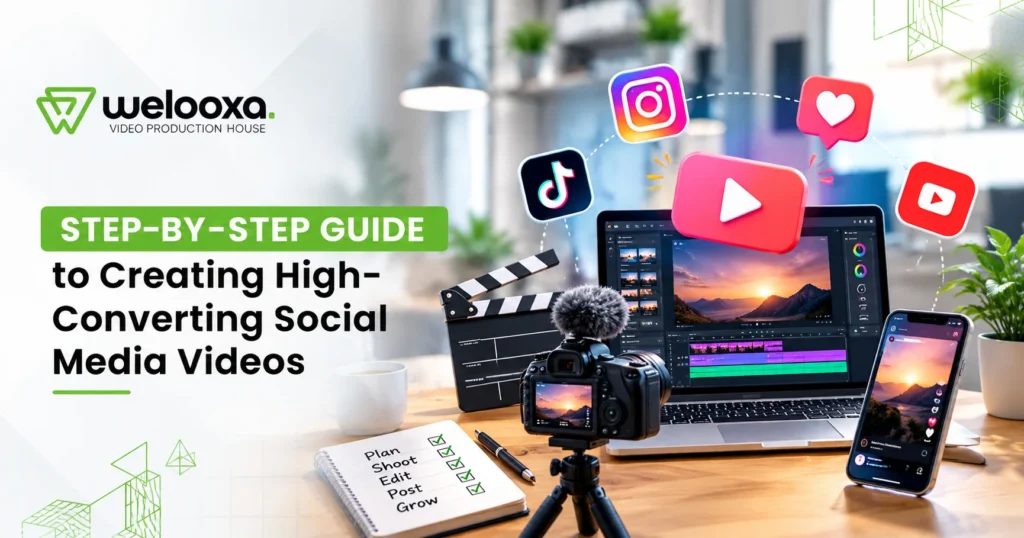
To create high-converting social media videos, define one audience and one goal, script a hook in the first 3 seconds, film vertically with clear audio, edit tightly with captions, end on a single call to action, and improve each video using retention and conversion data.
Video is no longer optional. In Wyzowl’s 2026 State of Video Marketing survey, 91% of businesses used video as a marketing tool, 82% of marketers reported a good ROI, and 85% of consumers said a video had convinced them to buy something. Social media videos were the single most common use case, created by 69% of video marketers (Wyzowl, 2026).
Yet most brand videos still fail to convert. In our work producing Reels, UGC and ad creatives for manufacturers, real-estate developers and D2C brands, the gap is rarely the camera. It is a missing strategy: no clear viewer, no single goal, and no plan for what happens after the view.
This guide walks through the exact seven-step workflow the Welooxa production team uses, from audience research to social media video editing and analytics. Each step is practical enough to apply this week, whether you shoot on a phone or hire a crew.
Step 1: Understand your audience before you press record
A high-converting video speaks to one specific person with one specific problem. Before scripting, answer four questions in writing:
- Who is watching? Age, location, language, job role and income bracket. A Gujarati-speaking homebuyer in Gandhinagar needs different videos from a procurement manager in Germany.
- What problem keeps them scrolling? List the top three pain points in your customers’ own words. Pull these from sales calls, reviews, WhatsApp enquiries and comment sections.
- Where do they watch? B2B buyers spend more time on LinkedIn and YouTube; younger consumers live on Instagram Reels and YouTube Shorts.
- How aware are they? A cold viewer needs a problem-led hook. A warm viewer who has visited your site needs proof, pricing or an offer.
Tailor content to buyer stage
Map every video idea to one stage. Awareness videos educate or entertain. Consideration videos compare, demonstrate and answer objections. Conversion videos show testimonials, guarantees and a direct offer.
Practical tip: Read the last 50 comments on your top competitor’s videos. Recurring questions are ready-made video topics, and they mirror the queries people type into Google and ask AI assistants.
Step 2: Build a social media video content strategy
A social media video content strategy turns random posting into a system that compounds. It connects every video to a business goal and a measurable result.
Set SMART goals
Replace “go viral” with goals like: “Generate 40 qualified WhatsApp enquiries per month from Instagram Reels by March 2027.” Each goal decides which metric you optimise for later in Step 7.
Choose video types by funnel stage
| Funnel stage | Best video types | Primary goal | Typical length |
|---|---|---|---|
| Awareness | Trends, tips, behind-the-scenes, myth-busting | Reach and follows | 7–30 sec |
| Consideration | Product demos, how-tos, comparisons, factory tours | Saves, shares, site visits | 30–90 sec |
| Conversion | Testimonials, UGC videos, offers, FAQs | Leads and sales | 15–60 sec |
| Retention | Onboarding, tutorials, community stories | Repeat purchase, referrals | 30–120 sec |
Plan pillars and a calendar
Pick three to four content pillars, such as education, proof, culture and offers. Then build a monthly calendar: for most brands, three to five short videos a week plus one longer YouTube piece is a sustainable starting cadence.
Batch production saves money. One well-planned shoot day can deliver 12–20 short clips. This is how a strong video marketing strategy stays consistent without a daily scramble. If you are budgeting for outside help, our breakdown of video production cost in India shows what each format typically costs.
Step 3: Social media video production, from script to shoot
Good social media video production is less about expensive gear and more about planning. Wyzowl found that 89% of consumers say video quality affects their trust in a brand, so clean light and clear audio matter more than cinematic cameras.
Equipment by budget
| Level | Camera | Audio | Lighting | Extras |
|---|---|---|---|---|
| Starter | Recent smartphone (4K, 30 fps) | Wireless clip-on mic | Window light or one ring light | Tripod, phone gimbal |
| Growing | Mirrorless camera with a fast lens | Dual wireless mics | Two LED panels with softboxes | Teleprompter app, reflector |
| Professional | Cinema camera plus a second angle | Boom and lavalier kit | Three-point lighting setup | Crew, sets, motion graphics |
Script with the hook–value–CTA structure
- Hook (0–3 sec): a bold claim, a question or a visual surprise. “Most factory videos lose buyers in five seconds. Here’s why.”
- Value (3–45 sec): deliver one idea, one demo or one story. Cut everything else.
- Proof (optional): a result, a number or a customer clip.
- CTA (last 3–5 sec): one action only, such as “Comment PRICE” or “Tap the link to book a visit.”
Filming tips that lift results
- Shoot vertical 9:16 first; you can crop for 1:1 or 4:5 feeds later.
- Keep the face or product in the upper-middle third, clear of on-screen buttons.
- Record room tone and test audio before every take; viewers forgive soft footage, not bad sound.
- Capture B-roll (hands, close-ups, process shots) for every talking point. It makes editing faster and pacing sharper.
For brands that want this handled end to end, a specialist social media video production company can script, shoot and deliver a month of content from a single shoot.
Step 4: Social media video editing that holds attention
Social media video editing is where average footage becomes a converting video. The goal is simple: give viewers no reason to swipe.
- Cut the first second. Start mid-sentence or mid-action. Remove intros, logos and “Hi guys.”
- Change the frame every 2–4 seconds. Use jump cuts, zooms, B-roll or text pops to reset attention.
- Add burned-in captions. Many people watch on mute, and captions also make your spoken keywords readable to platforms.
- Use sound deliberately. Trending audio helps reach on Reels and Shorts; licensed music is safer for ads and brand pages.
- Keep branding light. A small logo bug and consistent caption fonts and colours build recognition without feeling like an ad.
- Design the last frame. End on the CTA text, or loop smoothly to the opening shot to lift replays.
Tools for every skill level
Beginners can work fast in CapCut or the platforms’ built-in editors. Growing teams often move to Adobe Premiere Pro or DaVinci Resolve for colour and audio control. AI-assisted tools now help with auto-captions, silence removal and resizing; Wyzowl reports that 63% of video marketers have used AI video tools to create or edit videos.
Use AI to speed up repetitive work, but keep a human editor on story, pacing and brand tone. That judgement is what separates content that converts from content that merely exists. If editing is your bottleneck, outsourcing to professional video editing services frees your team to focus on ideas and distribution.
Step 5: Optimize videos for SEO, AI search and platform algorithms
Social platforms are now search engines, and Google, AI Overviews and AI assistants increasingly surface video. Optimise every upload so both people and machines understand it.
Video SEO best practices
- Lead with the keyword. Put the main phrase in the first line of the caption or title, written the way people search: “how to style a 2BHK on a budget”, not “Interior Inspo #47.”
- Say the keyword out loud. Platforms transcribe speech, so naming the topic in the first sentence strengthens relevance.
- Use 3–5 specific hashtags rather than 30 generic ones.
- Add on-screen text and alt text where the platform allows it.
- Embed videos on your website with a transcript, a descriptive heading and VideoObject schema so Google can index them.
- Answer one question per video. Clear question-and-answer framing is the format AI Overviews and answer engines quote most easily.
Signals the algorithms reward
Across Instagram, YouTube, TikTok and LinkedIn, ranking systems broadly reward the same behaviours: watch time and completion rate, rewatches, shares, saves, and meaningful comments. Post when your audience is active, reply to comments in the first hour, and keep a consistent posting rhythm.
Build E-E-A-T into the video itself
Show real experience on screen: your team, your workshop, real clients and real results. Name the presenter and their role. Link to your portfolio or case studies in the bio or description. These trust signals help viewers, and they give search engines and AI systems reasons to treat your brand as a credible source.
Step 6: Short form video content best practices
Short form video content (under 90 seconds) is the fastest way to earn reach. Wyzowl found that 63% of consumers would most like to learn about a product through a short video, ahead of articles, ebooks and webinars.
Win the first 3 seconds
- Open on movement, a face or the end result, never a logo.
- Put a text hook on screen that works without sound.
- Make a promise the video keeps: “3 mistakes that make your Reels flop.”
- Deliver one idea only. If you have three, make three videos.
Platforms to prioritise
| Platform | Best for | Aspect ratio | Sweet spot |
|---|---|---|---|
| Instagram Reels | D2C, lifestyle, real estate, local brands | 9:16 | 15–45 sec |
| YouTube Shorts | Education, discovery, driving viewers to long videos | 9:16 | 20–60 sec |
| LinkedIn video | B2B, manufacturing, thought leadership | 9:16 or 1:1 | 30–90 sec |
| Facebook Reels | Older demographics, community, retargeting | 9:16 | 15–60 sec |
| TikTok (where available) | Trends, entertainment, Gen Z | 9:16 | 15–60 sec |
Shoot once, then adapt per platform: change the hook text, caption style and CTA rather than posting identical files everywhere. When a short video performs well organically, turn it into a paid creative; proven organic winners usually make the strongest video ads.
Step 7: Measure success and improve every month
Views feel good, but conversions pay the bills. Wyzowl found that 67% of marketers measure video ROI by views while only 32% track bottom-line sales. Track the metric that matches your goal from Step 2.
| Goal | Metrics to track | What a weak number tells you |
|---|---|---|
| Awareness | Reach, 3-second view rate, follower growth | The hook or thumbnail is not stopping the scroll |
| Engagement | Average watch time, completion rate, saves, shares | The middle drags or the value is unclear |
| Traffic | Profile visits, link clicks, click-through rate | The CTA is weak or the offer is not compelling |
| Conversion | Leads, enquiries, sales, cost per lead | The landing page or offer does not match the video |
Adjust strategy based on analytics
- Review weekly, decide monthly. Single videos are noisy; look for patterns across 10–20 posts.
- Study the retention graph. A sharp drop at second two means a weak hook; a drop mid-video means a slow section.
- Test one variable at a time: hook, length, presenter, caption or CTA.
- Double down on winners. Remake top performers with a new angle, and retire formats that underperform for six or more posts.
- Connect to revenue. Use UTM links, unique offer codes or “Where did you hear about us?” fields to tie videos to real sales.
This feedback loop is what turns social media video marketing from guesswork into a predictable growth channel.
Conclusion: turn views into customers
High-converting social media videos follow a repeatable system: know your viewer, plan around a goal, hook fast, edit tightly, optimise for search and measure what matters. Start with one pillar and one platform, publish consistently for 30 days, and let the data show you what to scale.
If you want a partner for strategy, shooting and editing, the team at Welooxa has produced social media, Reels, UGC and ad videos for brands across India since 2020. Browse our portfolio or contact us to get a quote for your next campaign.
Frequently asked questions about social media video production
What equipment do I need for social media videos?
You need a recent smartphone, a wireless clip-on microphone, a tripod and soft, even light from a window or ring light. Audio and lighting improve results more than a better camera. Upgrade to a mirrorless camera only once you post consistently.
How long should my social media videos be?
For Reels, Shorts and TikTok, 15–60 seconds works best for most brands. LinkedIn and Facebook videos can run 30–90 seconds. Wyzowl’s 2026 survey found 71% of marketers rate 30 seconds to 2 minutes as most effective. Length should match the idea, never padding.
What types of videos perform best on social media?
Short educational tips, behind-the-scenes clips, product demos, customer testimonials and user-generated content consistently perform well. Videos that answer one clear question or show a real transformation tend to earn the most saves and shares, which platforms reward with reach.
How often should a business post videos on social media?
Three to five short videos per week is a strong, sustainable target for most businesses. Consistency matters more than volume. Batch-shooting one day a month makes this cadence realistic for small teams.
How much does social media video production cost?
Cost depends on format, crew size, locations and editing complexity. Phone-shot in-house videos cost mainly time, while agency packages cover strategy, shooting and editing. See our guide to video production cost in India for typical ranges.
Should I create videos in-house or hire an agency?
In-house works for quick, frequent, personality-led content. An agency makes sense when you need strategy, polished product videos, ads or consistent volume. Many brands combine both: in-house daily posts plus agency-produced hero and ad content.